Covering the fields of transportation, energy, and water, this research report aimed to portray the current situation of smart cities in Turkey and shed light on the creation of a nationwide smart cities roadmap and strategy to be developed accordingly. This study was conducted in Turkey’s metropolitan municipalities, their affiliated administrations, district municipalities, water administrations, and energy distribution companies under the collaboration of the Turkey Informatics Foundation (TBV) and Istanbul Technical University Computer Engineering Department, designed and implemented by the Novusens Smart Cities Institute, and sponsored by Mastercard and Intel Turkey...
Just like in many countries around the world, smart city initiatives are gaining momentum in Turkey as well. According to the "Global Metro Monitor" published by the Brookings Institution in 2015, the world's fastest-growing metropolitan areas are located in China, Turkey, and the Middle East. According to the index published in the report, four cities from Turkey rank among the top 10 fastest-growing metropolitan cities in the world: Izmir, Istanbul, Bursa, and Ankara.
In this context, a study has been conducted to serve as a reference for all institutions and organizations working on smart cities both in our country and abroad. This study was planned in two phases, and the first phase has been completed. Serving as a current situational analysis, the outcome of the first phase reveals striking results in the areas of transportation, energy, and water, as well as the steps that can be taken in the upcoming period.
Within the scope of the "Turkey Smart Cities Assessment Report," numerous face-to-face interviews were conducted with the relevant institutions and organizations. In addition to these interviews, an online survey tool was designed and implemented to gather information regarding the applications and approaches to smart cities. In this study, respondents were asked to consider smart city applications in the focused areas of transportation, energy, and water that directly affect and benefit citizens, and possess the following characteristics:
Data collection: Collecting data on the relevant field through systems/smart devices/sensors used for measuring and monitoring urban conditions.
Data communication: Transmitting the collected data to other systems/devices/centers through wired or wireless networks.
Data analysis: Analyzing urban data about the relevant field to be used for real-time decision-making or future insights that will benefit citizens, such as:
Sharing real-time data in a way that is understandable for authorities/citizens,
Optimizing data for load balancing,
Making future predictions.
Smart City Definitions
Cities are centers of creativity and innovation. However, factors such as population growth, rapid urbanization, and climate change cause cities to face increasing pressures and challenges in areas like transportation, environment, and healthcare.
According to the "Global Metro Monitor," the world's fastest-growing metropolitan areas are located in China, Turkey, and the Middle East. According to the index published in the report, four cities from Turkey rank among the top 10 fastest-growing metropolitan cities in the world: Izmir, Istanbul, Bursa, and Ankara.
The ITU Faculty of Computer and Informatics provides academic support for studies that will guide the widespread implementation of the "Smart City" concept in Turkey. "Turkey Smart Cities Assessment Report" press conference (from left to right): Dean of ITU Faculty of Computer and Informatics Prof. Dr. Sema F. Oktuğ, MasterCard General Manager Yasemin Bedir, Vodafone Turkey Executive Board Vice President Engin Aksoy, Novusens Smart Cities Institute Co-Founder Berrin Benli, Turkey Informatics Foundation President Faruk Eczacıbaşı, Intel Turkey General Manager Burak Aydın.
Cities are encouraged to become smart in order to overcome these challenges and even turn them into opportunities. Nonetheless, the concept of a smart city is extremely broad and complex, and there is no universally agreed-upon definition. While some definitions of smart cities are comprehensive, others are focused on technology, data, or citizens.
The common point in most smart city definitions is that they involve cities solving their sustainability challenges regarding economic, social, and environmental issues through the use of smart technologies and data. Below you can find some of the aforementioned smart city definitions:
A smart city consists of effectively integrated digital and human systems to deliver a sustainable, prosperous, and inclusive future to its citizens (British Standards Institution – BSI).
Smart cities are places where traditional services and networks are made more efficient with the use of digital and telecommunication technologies for the benefit of its residents and businesses (European Union).
A smart city is a city that uses information and communication technologies to enhance its liveability, workability, and sustainability (Smart Cities Council).
Approach
The study was conducted in Turkey’s metropolitan municipalities, their affiliated administrations, district municipalities, water administrations, and energy distribution companies. Within the scope of the project, numerous face-to-face interviews were held with these institutions. In addition, an online survey specifically designed for the project was implemented to gather data on smart city applications from various perspectives.
Subsequently, the results obtained from the survey were analyzed in depth to reveal current approaches, insights, challenges encountered, and factors contributing to the success of smart city projects.
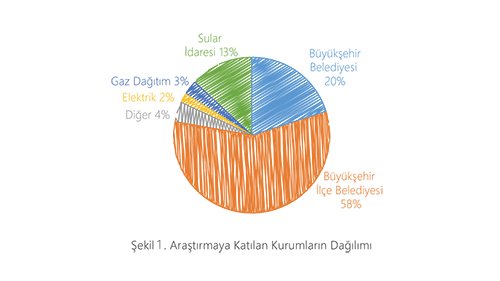
When looking at the distribution of the 105 participating institutions, one-fifth (21 institutions) are metropolitan municipalities, and two-thirds of these have a population exceeding 1 million. More than half of the respondents consist of metropolitan district municipalities (60 institutions). Affiliated water administrations of metropolitan municipalities (14 institutions) constitute 13% of the participating organizations. Similarly, the 4 institutions listed under the "Other" category are also administrations affiliated with metropolitan municipalities. Therefore, metropolitan municipalities and their affiliated organizations make up approximately 37% of the total participating institutions. Energy distribution companies comprise about 5% of the respondents (Figure 1).
Main Findings
Although smart cities offer numerous solutions with the help of technology, it is crucial that their focus remains on people rather than technology itself. Utilizing technology as a tool to support and enhance the quality of life of citizens holds a key importance for the success of smart city applications. The main findings identified in this study are listed below:
Financial inadequacy was reported as the most significant challenge in smart city applications, with approximately 60% of the respondents indicating the use of municipality resources for this purpose.
Lack of collaboration among institutions emerged as another major obstacle to smart city applications. Concurrently, it was ranked at the top among the critical success factors required for projects to succeed. It was observed that collaboration especially with non-governmental organizations (NGOs), universities, and other municipalities could be further improved.
Innovative approaches in smart city applications ranked first among the critical success factors for the participants. Institutions need to closely follow and internalize developments in smart city technologies, and pay attention to issues such as change and innovation management in order to adapt these technologies quickly to the needs of the city.
Expertise in information and communication technologies (ICT) was stated as one of the most critical success factors in smart city applications. When considered together with the lack of knowledge and experience regarding smart cities, the importance of competent human resources in applications becomes evident.
Inclusion of citizens in the process is deemed important for the success of smart city projects. Meanwhile, easing citizens' lives and improving their living standards ranked first among the primary objectives of smart city applications.
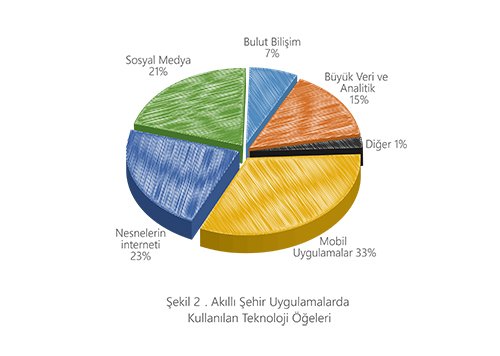
It was observed that current smart city applications do not utilize cloud computing and big data analytics to the expected extent. On the other hand, mobile applications are very widely used (Figure 2).
Geographic Information System (GIS) infrastructure is considered one of the most vital elements for the success of smart city applications, yet it is simultaneously evaluated as one of the most significant barriers during the implementation of these projects.
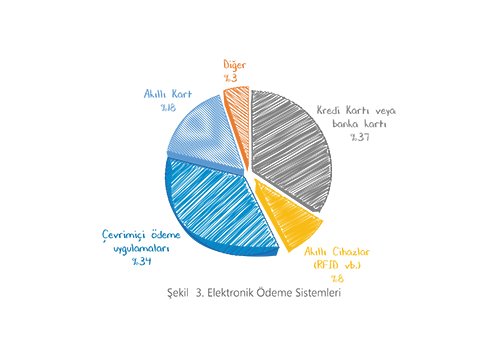
Payments via smart cards or smart device applications are utilized by a quarter of the respondents, and these applications are predominantly in the field of transportation (Figure 3).
Approximately 90% of the participants found it beneficial to open up local data generated by smart city applications to public use for developing ICT-supported, innovative solutions, provided that information security and privacy principles are respected.
Two out of every three metropolitan municipalities participating in the study plan to implement smart applications in transportation, followed by prominent planned investments in the fields of energy and water, respectively.
The most common smart applications in the field of transportation are traffic monitoring systems, electronic payment systems, and smart stops.
The most widespread smart applications in the field of energy are smart street lighting systems, followed by electricity distribution, smart grids, and smart electricity meters.
Electronic payment systems rank at the top of smart applications in the field of water, followed by smart water meters, demand management, and automated water quality monitoring.